As we relaunch the AMP Advanced Leadership course, Richard Penley Martin explains why managing upwards is one of the defining skills of the modern golf club manager.
Running a golf club means making decisions in an environment where authority, accountability and influence do not always sit in the same place.
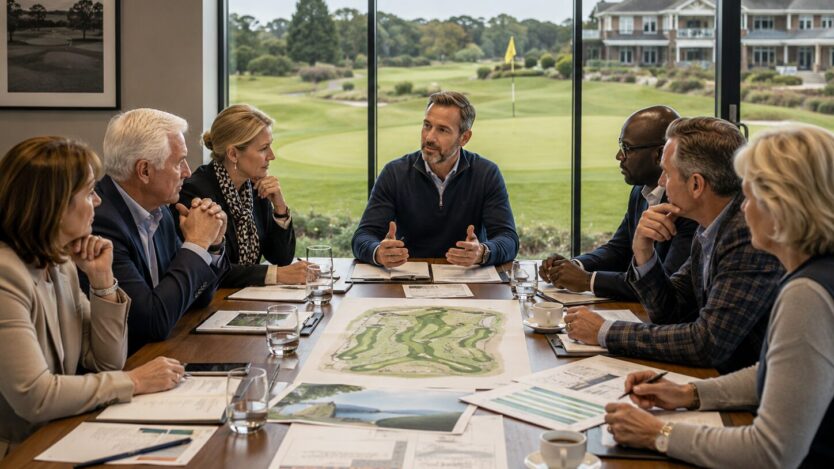
General managers lead teams, support department heads, work with members and deliver the club’s plans. But they must also lead upwards, building effective relationships with boards, committees, captains and volunteers whose decisions shape the club.
We have put renewed focus on those demands through the refreshed Advanced Management Programme Leadership Award, Leading and Managing People, which explores areas including emotional intelligence, difficult conversations and stakeholder influence within the unique environment of a golf club.
Richard Penley Martin knows that environment well. Before retiring after 30 years in golf club management, he worked at a world top 100 club and a UK top 100 club, opened a new golf club at the start of its journey, served on the GCMA General Committee and education sub-committee, and was one of the association’s first mentors.
That breadth of experience has given him a clear view of one of the most complex parts of the role. Board members may be volunteers. Committee members may also be customers. Captains change regularly. Strong personalities can emerge around the table, and the general manager must influence decisions without appearing to overstep.
“The most important thing you have to remember is that it’s not your business,” he said. “Even if you’re working for a proprietary owner, you’ve still got somebody you’re reporting to.
“The key to me was ensuring that you had a structure, a published structure, so everybody knew where they fitted into the organisation. That’s as much for the team who are working for you as it is for the board members and committees who you’re reporting to. They need to know how they fit into the structure, so people don’t go round other people, either accidentally or deliberately.”
A general manager may have the professional expertise, daily understanding and confidence to know what should happen, but the club does not function well if authority is allowed to drift or if people are uncertain about where decisions sit.
In private members’ clubs, Richard found role descriptions particularly important. They helped define how volunteers connected with paid staff, what directors were responsible for and where boundaries needed to be respected. When new board members were due to join, he would send them key documents and links to a document portal, then sit down with them individually or as a group to talk through what they needed to know.
He also encouraged them to read recent board minutes, so they understood the live issues facing the club before they entered the room.
“Our directors were only on the board for three years, so we needed them to hit the ground running,” he said. “They couldn’t take a year to settle in, because we didn’t have that time with them to get them productive.
“That was to prevent any issues with people overstepping boundaries or anything like that. It was also to give them a good read into their position, what the key things were and what the issues were that we were dealing with.”
The point was not to bury volunteers in process. It was to make working relationships easier. When people understand the structure, conversations can be more productive and less personal. Disagreement becomes easier to handle because everyone has a shared reference point.
That matters when a manager has a strong view on what should happen but needs to bring others with them. Richard did not see influence as a matter of lobbying board members in advance or trying to engineer support behind the scenes.
“I’ve never considered myself a political animal,” he said. “I don’t have time to go round having machinations with people, taking them aside ahead of a board meeting and saying, ‘This is the decision I want to get to and this is why’.
“I relied on the fact that I presented the information they needed to make the correct decision, and occasionally it would go against you. Again, that comes down to remembering it’s ultimately not your toy, it’s theirs, and you’re managing on their behalf.”
That is one of the hardest parts of managing upwards. The general manager can advise, guide and make the strongest possible case, but the board may still decide differently. Professionalism is tested most when the manager later proves to have been right.
“Despite your best advice, they will make a wrong decision,” he said. “The key thing is not to turn around when it all goes wrong and go, ‘I told you so.’ That doesn’t help.”
Trust is built when boards know the manager is not trying to win every exchange. It is also built when the chair and directors feel properly informed. Richard valued the freedom to get on with the job, particularly once budgets and plans had been approved, but he also recognised the importance of making sure the chair was never caught out by members asking questions.
“The biggest thing is remembering to tell the chairman everything you’re doing,” he said. “It’s the ‘I don’t want any shocks’ solution. By all means, get on and do stuff, but just tell me that you’re doing stuff, so that if a member comes up and asks why we have done something, I’ve got an answer.
“One of your jobs is to make your boss look good and, in that case, he’s your boss.”
Although directors have a strategic role, they still need to be kept informed about issues in their areas. At the same time, the general manager is responsible for ensuring they carry out any actions assigned to them by the board. This can be challenging, but with good communication it should not be seen as nagging – particularly if the general manager can offer clear guidance on what needs to be done, supported by input from the heads of department.
That does not mean a manager should refer every operational decision upwards. In Richard’s experience, good boards give the general manager the space to operate. The judgement lies in recognising when an issue crosses from day‑to‑day operations into strategic responsibility.
“There are times when you have to go and ask for a decision rather than just acting as a general manager and going, ‘That’s my role, so I’ll just go ahead and do it,’” he said. “It’s where those boundaries cross, where operational and strategic are closely connected.
“Sometimes you go ahead and do something and then think retrospectively, actually, I probably should have asked before I cracked on.”
The same principle applies when individuals begin to move away from agreed plans. In those moments, the manager’s behaviour can either inflame the situation or bring it back to the club’s agreed direction.
“If I see a director who is going off on a tangent, I can politely have a chat with them and say, actually, this isn’t what we’ve agreed,” he said. “This is what the board’s agreed. If we’re going to change this, you and I need to go back to the board and explain why we think it’s not the right tack.”
That approach keeps the discussion attached to the collective decision rather than the personality of the person raising it. It is particularly important in golf clubs because members who volunteer often care deeply about the club, but may also arrive with a personal view of what needs to change.
“You’re not coming on to represent your Saturday fourball,” he said. “You’re coming on to represent all the members who’ve elected you, even the ones who didn’t vote for you. You’re running this golf club for the benefit of the majority of the golf club, not the minority.”
That majority view helped Richard stay calm when decisions were unpopular. He accepted that no manager, board or committee could please everyone.
“My satisfaction rate for members I aimed for was 95%,” he said. “I knew every decision I made, or we made as a board, was going to annoy somebody.”
The behaviours that strengthen working relationships are often simple, but they take discipline. Preparation matters. So does consistency. So does the ability to listen without becoming defensive, especially when the conversation is difficult or emotionally charged.
“A lot of the time, it can be just being diplomatic,” he said. “Somebody says something and you don’t react straight away. Take 10 seconds to think, or say, ‘I’ll come back to you on that.’
“Sometimes you just need to listen and not say anything, rather than jump in. A lot of people think they need to give an answer straight away because somebody’s asked, when actually sometimes you’re better off sitting on your hands and saying, let me think about that.”
That restraint is not passive. It is part of how a manager becomes a trusted adviser rather than simply an operational expert. Boards and committees need the general manager’s knowledge, but they also need confidence that advice will be calm, considered and rooted in the best interests of the club.
“If the club loses confidence in you, it’ll be in this area,” he said. “It will be because you’re not managing it.”
The manager who can influence without creating friction, disagree without making it personal and keep the right people informed gives boards and committees a stronger platform from which to lead.
Get involved…
The GCMA has refreshed the Advanced Management Programme Leadership Award – introducing an updated programme providing Golf Club Managers with a high-quality immersive learning and personal development experience.
Designed and delivered by specialist training provider Progrezo, the three-day residential programme brought together under the Leading and Managing People banner sees delegates examine a range of topics including leadership styles, performance management, coaching and feedback, emotional intelligence, difficult conversations and stakeholder influence, while also developing a personalised plan for professional growth.
The next course is hosted at Moor Park Golf Club, from October 6 to 8. Click here to learn more or download the full Leading and Managing People brochure.