Fulwell Golf Club Secretary Murray Cook explores isolation, decision fatigue and protecting yourself as a leader.
As managers, there is an expectation that you will always have the answer. Staff bring operational problems, members raise concerns, boards seek guidance and captains arrive with priorities for their year in office.
Sitting at the centre of those relationships gives managers considerable influence over the direction of their clubs. It can also leave them carrying pressure that cannot easily be shared.
The unique challenges of leading within a golf club are explored through our refreshed Advanced Management Programme Leadership Award. Brought together under the Leading and Managing People banner, the three-day residential programme examines areas including leadership styles, emotional intelligence, difficult conversations and stakeholder influence.

Murray Cook, who has been Secretary at Fulwell Golf Club since 2015, understands those demands well.
After graduating from Bournemouth University with a degree in Sports Management (Golf), Murray worked in golf retail and spent two seasons in golf services at Celtic Manor. He arrived at Fulwell as Assistant Secretary in 2013 and stepped up to the senior role two years later, aged 27.
More than a decade at the Middlesex club has given him an insight into how the relationships surrounding a manager can either ease the pressures of the position or leave them feeling increasingly isolated.
When the negatives become massive
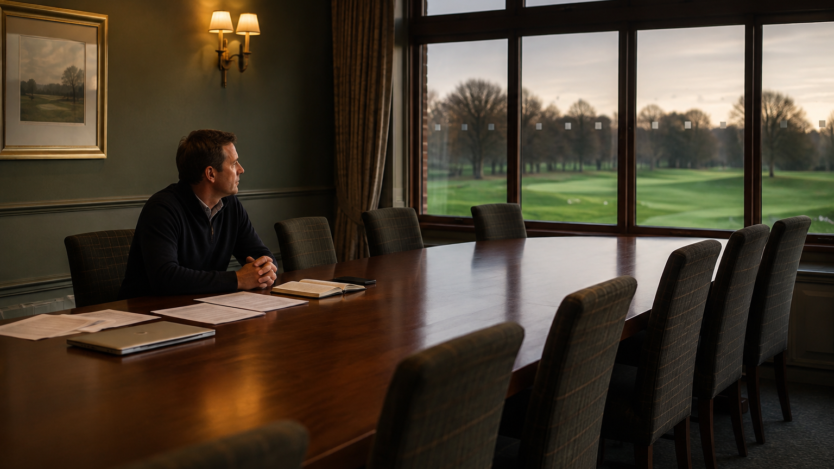
“Golf club management can be a lonely role because you are often the person everyone comes to, but not necessarily the person who has someone to turn to,” Murray said.
“You are balancing the expectations of members, the board, staff, captains and committees, often with competing priorities and very different views of what ‘great’ looks like.
“You also have to be careful about where you share your frustrations. You can’t always talk openly with staff, members or board colleagues, so you can end up carrying difficult decisions and conversations yourself.
“The challenge is that the manager is expected to remain calm and professional, even when the pressure is coming from every direction.”
Murray believes the extent to which a manager feels alone can depend heavily on their relationship with the club’s leadership. He works closely with Fulwell’s chair and has the confidence of a supportive board whose ambitions are aligned with his own.
That reassurance means he can make day-to-day decisions knowing they will be supported, provided they serve the club’s agreed direction. Without it, managers may find themselves continually second-guessing how their decisions will be received.
There will still be occasions when a manager has to accept that a decision will make them unpopular.
“You might not be liked for a decision, but you have to know that what you are saying and doing aligns with the overall club goals,” Murray said.
“You might have hundreds of happy members, but a few loud complaints can be draining. If you expect to be thanked for everything you do, you are going to feel isolated because all the negatives will become massive and you won’t see the positive things you have done.
“You have to have strength and courage in what you are doing, and you have to believe in it. Golf club management is more than just a job. You have to love what you are doing because the negative impact of some feedback, or ‘constructive criticism’ as members might call it, can really drain you.”
Deciding what really needs you
Even apparently straightforward decisions can require a manager to consider the effect on several parts of the club. Murray gives the example of deciding whether to accept an event booking. The answer requires much more consideration than whether the proposed date is available.
“What day is it? What other events have we got in the lead-up? How much revenue will it bring in? How much impact will it have on the members? Will there be a course closure or a partial closure? Have I got the staff?
“It is a very well thought-out decision, but sometimes members don’t see that. They just think you have said yes to it.
“I try to think about everyone’s views. Closing the golf course on a Tuesday will affect one group of people. Closing it on a Thursday will affect another. Closing it on a Saturday will have a completely different scale of impact.”
Having to conduct that assessment repeatedly can contribute to decision fatigue. Murray believes managers can reduce the mental load by creating structure around the choices that reach them.
“The first step is recognising that you don’t have to make every decision immediately,” he said. “Not everything is urgent, and creating some structure around decision making can make a huge difference.
“Clear priorities, good processes and knowing what genuinely needs your involvement help reduce the mental load. Delegating is also important, not simply to reduce your workload, but to give capable people ownership and responsibility.
“Experienced managers learn to separate the important decisions from the emotional noise around them. Members may have strong opinions, captains may have different priorities and boards may challenge decisions. You have to listen to all of that without allowing every opinion to become your responsibility.”
At Fulwell, responsibility for the golf operation, clubhouse and course is distributed among the relevant department heads. They are trusted to make decisions consistent with the club’s strategy rather than referring every issue upwards.
“I prefer someone to try and fail than fail to try,” Murray said. “They know that if they make a decision, I will back them publicly. If we need to review it afterwards, we will review it and may make some changes.
“They know they have my support, in the same way that I have the support of the board. I think that is crucial.”
Finding support and perspective
A strong internal structure can make the role more manageable, although managers also need people beyond their own club with whom they can speak openly.
“One of the most valuable things a manager can have is a trusted network of people who understand the role,” Murray said. “That might be other golf club managers, industry colleagues, mentors, professional associations or simply someone who has been through similar situations.
“Sometimes you don’t need someone to give you the answer. You just need someone who understands the situation and can say: ‘I’ve been there. Here’s how I dealt with it.’
“Getting outside your own club environment is particularly important. When you’re dealing with the same issues day after day, it can be difficult to see the bigger picture.
“A conversation with someone independent can provide perspective and remind you that not every difficult situation is a reflection of your ability as a manager.”
That sense of perspective can also help managers avoid taking every criticism personally. Murray regards himself as a custodian of Fulwell, responsible for helping the club progress during his time there while recognising that its identity extends far beyond any one individual.
“There will be a time when I leave and the golf club will remain,” he said. “It will still be a healthy and positive golf club, and I will have played a part. It was here long before I arrived and it will be here long after I leave.”
Investing in the person leading the club
Finding space away from work remains a challenge. Murray plays football and golf, attends Aston Villa matches and spends time with friends and family, although he accepts that he does not always switch off completely. That makes deliberate investment in personal development and wellbeing particularly important.
“The club can only be as healthy as the people leading it,” he said. “Managers spend a huge amount of time investing in their staff, facilities, members and the future of the club, but it is easy to put themselves at the bottom of the list.
“Investing in yourself doesn’t necessarily mean formal qualifications or expensive courses. It can mean developing your leadership skills, finding a mentor, attending industry events, protecting time away from the club or simply continuing to learn.
“The better supported, more confident and more resilient you are, the better decisions you can make for the club and the people around you. Looking after yourself isn’t selfish. It is part of being a sustainable and effective leader.”
Get involved…
The GCMA has refreshed the Advanced Management Programme Leadership Award, introducing an updated programme that provides golf club managers with an immersive learning and personal development experience.
Designed and delivered by specialist training provider Progrezo, the three-day residential programme examines the practical challenges of leading and managing people while helping delegates develop a personalised plan for professional growth.
The next course will be held at Moor Park Golf Club from October 6 to 8. Find out more about the Advanced Management Programme and book your place.