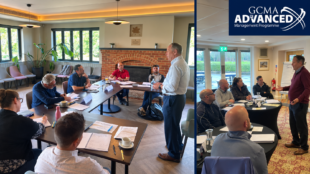
Chesterfield Golf Club General Manager and GCMA Director Sean Boyle explains how communication and evidence-based reasoning can help managers overcome resistance.
Securing support for change is one of the most persistent leadership challenges facing golf club managers. A proposal may be well founded and serve the club’s long-term interests, but that does not guarantee it will be welcomed by members, staff or committees.
Influencing others and creating outcomes that different stakeholders can support are among the topics covered by the refreshed Advanced Management Programme Leadership Award, Leading and Managing People.
The three-day residential programme explores the challenges of leading and working with people within the unique environment of a golf club, encompassing leadership styles, performance management, coaching and feedback, emotional intelligence, difficult conversations and stakeholder influence.

Sean Boyle is General Manager at Chesterfield Golf Club and one of our Directors. Before moving into golf club management in 2018, he spent 10 years in newspaper journalism and a similar period managing public relations and communications teams in political settings, with a specialism in crisis communications.
Here, Sean considers why proposals encounter resistance and how managers can bring people with them when their plans are challenged.
Why can a seemingly sound proposal still meet resistance within a golf club?
Even the best proposals will encounter pockets of resistance – no matter the nature of a business, organisation or life in general – and we must do our best to pre-empt and be prepared for them.
I’d say there are probably two key reasons for this, both of which can be mitigated against, one more so than the other.
The first is a general lack of understanding of the proposal – those affected just don’t get what it is all about. Why is this? Generally, this means the proposal has not been shared in an understandable way. We can guard against this by having a structured communications plan running alongside development of the proposal. It doesn’t need to be complicated, but the plan should seek to make sure members have accurate and timely information in support of the proposed action.
I’m a big believer in ‘arming the advocates’. By this I mean sharing key information with members, so that they’re in a position to cascade it to their mates and playing partners and, importantly, to correct them if they’ve got the wrong end of the stick or are fabricating their own ‘truths’.
I’d advise fellow managers not to be afraid of holding a member forum even if they think only 20 people will turn up. This is still a very valuable and worthwhile exercise. Think of yourself as being the start of the information chain – what follows is the multiplier effect – 20 soon becomes 200 once people talk. If we don’t issue timely updates, members are very good at filling the information void.
The second obstacle is harder to budge, but we can still nudge it in the right direction. I firmly believe that everyone views the world through their own prism – again, it doesn’t matter what aspect of life this is, it could be work, politics, shopping choices. The first thing people think when confronted with change is: ‘how will this affect me?’ It’s a natural reaction and one which we have to be mindful of and tap into to give best opportunity of turning it into a positive. Basically, to do this, we put ourselves in the position of the message recipient.
When we consulted on our governance change proposals a couple of years ago, we tailored the messaging to different membership groups – seniors, ladies, past captains and so on – always mindful that each group would be looking at it through their own prism. It worked a treat and the proposals were voted through by members with over 95% support, helped by many of the biggest advocates being from the groups we had taken the time to get on side by tailoring our messaging so that they had a thorough understanding of the benefits to them. They were our ‘influencers’.
When I’ve been invited to present to fellow GCMA members on the importance of positive and transparent member communication, I’ve used the following definition of communications. It’s my own, definitely isn’t from the textbook as it combines aspects of communications and marketing, the purists will hate it, but for me it sums up how we should be looking to communicate with the membership in our roles as golf club leaders:
‘Effective communication is simple. Identify the recipient and the desired behaviour change. Determine the message content and the best way of delivering it. Deliver it. Ensure they understand. Listen to the response and react’.
Let’s be absolutely clear: Understanding is the important part, as without understanding there is no communication.
In following this simple communication pathway, we won’t go far wrong, and will reduce the likelihood or ferocity of pushback.
What should a manager do first when someone raises an objection?
As with any interaction, when an objection is raised our first reaction must always be to listen – no matter how painful it may be. It is essential to ensure the objector feels heard and we need to understand the source and motivation of the objection before we even think about how to respond.
What we choose to do next will clearly be adapted to the situation and the relationship with the objector. If the objector is irate when making the objection, might it be better to say you’ve taken on board what they’ve said, will seek further information, and will respond within 48 hours? Fighting fire with fire can be very tempting, we’re all programmed to ‘win the argument’ – but will it do us any good in the long run? Embarrass a member in front of their pals and you’ve made an enemy for life. If we’ve decided to delay a response, giving a clear timeline is important to set member expectations.
Of course, more often than not, the best way to diffuse or influence is to have a sensible and measured conversation. We need to read the room, read the audience, understand the situation, and determine how best to ensure the best outcome. I believe having the emotional intelligence to be able to do this is one of the key traits which sets the best managers in our industry apart from their peers.
How can you establish what is really behind the pushback?
Let’s talk. The only way to establish why someone feels the way they do is to engage. Although not always possible, preferably this will be verbally – even better if face-to-face.
The personal touch also offers reassurance that you care about what they want to say – and often means that they open up in a way which may not happen in the written word and they will likely be more receptive to your reasoning. Face-to-face is particularly important if you’re apologising for a mistake or trying to placate someone. Let them see the human side of you, we’re not robots.
How should your approach change when dealing with staff, members or committee members?
For me, change management is always about taking people on a journey with you – right from the outset, not when you’re about to reach the destination.
You need buy-in. To get that buy-in, you need collaboration. To get that collaboration you need effective communication – and that has to be two-way.
Right at the outset, let’s have a conversation about what we’re trying to achieve and why we want to achieve it. We’re surrounded by very capable staff who we employ because they’re good at their job. They are often closer to the problem at hand than we are – why wouldn’t we encourage them to generate and share a solution? And why wouldn’t we listen to their suggestion? We’d be daft not to.
In this situation it is important to recognise that the answer or suggestion has come from the staff member. Make sure they feel the love! There is nothing more annoying, or short-sighted, than a manager who presents someone else’s idea as their own.
When should a manager adapt their proposal in response to an objection?
For major decisions, it will likely be a board-owned proposal – even if it has started with the general manager’s recommendation.
In such circumstances, whether the board decides to adapt or stick with its original proposal in the face of objections and opposition, it is vital that collective responsibility is maintained.
It is also vital that clear messaging is shared – be that with an individual member, group of members, or the whole membership – which gives the rationale for a project being pursued.
If it is to be adapted, we’d adopt a similar approach – making clear that we’ve run an open and transparent process and have listened and acted on feedback.
Always look to be able to answer the ‘why?’ question before it is asked. Why have we maintained the original position? Why have we adapted our position? Why have we abandoned the proposal altogether?
What helps turn disagreement into an outcome people can support?
Investing time in explaining the rationale for a decision will always reap rewards in the long run. I’m a big believer in data-led responses. As golf club managers, we have so much information available to us these days.
Our halfway house is open seven-days-a-week year-round, but if we were to take a decision to close it say two days per week, we’d be sensible to start our thinking by basing that on the average income for each day of the week. If we chose to close it on Tuesdays and Thursdays because they’re days of least income as a result, members playing on those days might not like it – but at least they have the rationale behind the decision.
Will it result in support from those objectors? Unlikely, but we’ll have shifted the needle in the right direction, so it’s success of sorts. All we can do is to provide the facts and rationale in an accessible and understandable manner, perhaps with a bit of humanity and humour thrown in!
Get involved…
The GCMA has refreshed the Advanced Management Programme Leadership Award – introducing an updated programme providing Golf Club Managers with a high-quality immersive learning and personal development experience.
Designed and delivered by specialist training provider Progrezo, the three-day residential programme brought together under the Leading and Managing People banner sees delegates examine a range of topics including leadership styles, performance management, coaching and feedback, emotional intelligence, difficult conversations and stakeholder influence, while also developing a personalised plan for professional growth.
The next course is hosted at Moor Park Golf Club, from October 6 to 8. Click here to learn more or download the full Leading and Managing People brochure.