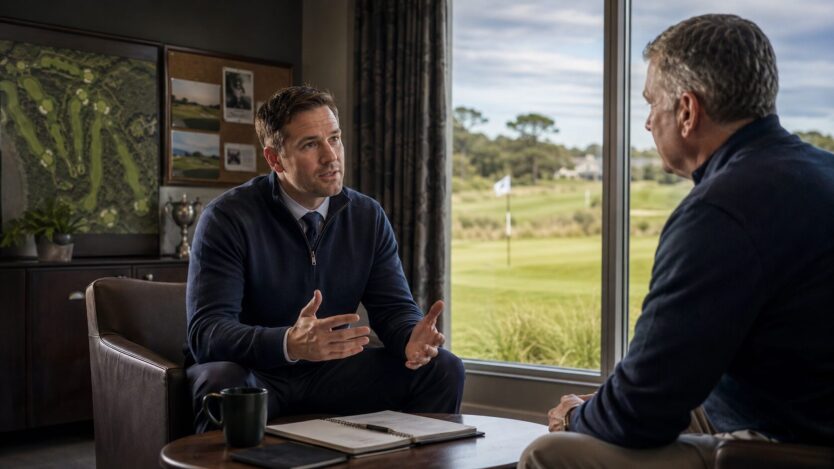
Ahead of the relaunch of the AMP Advanced Leadership course, Olton Golf Club General Manager David Holmes tackles a topic all GMs have to face.
Difficult conversations are unavoidable in golf club management. Working with staff, members, committees and boards regularly calls on a manager’s powers of communication.
We have put renewed focus on those demands through the refreshed Advanced Management Programme Leadership Award, Leading and Managing People, which explores areas including emotional intelligence and the art of managing upwards within the unique environment of a golf club.
David Holmes, General Manager at Olton Golf Club, believes handling difficult conversations is a skill that can be developed.

“People are not born with this natural skill of having difficult conversations,” he said. “But it is a skill you can learn. It is something that you can work on. You get better at it the more you do it.
“Ultimately, this job is about people and relationships. It is maybe something that you shy away from when you are younger and earlier in your career because no one has ever told you how to do it. As you do it more, you can see that these conversations are really important and, if you handle them in the correct way, they can be really productive.”
Managers may delay because they fear the reaction, worry about getting a formal process wrong or hope the problem will disappear. However, putting things off usually makes the eventual conversation harder.
“You are putting yourself in an uncomfortable situation, talking about things you would much rather ignore, but that problem will not go away,” David explained. “It festers and gets worse the longer you leave it.
“The earlier you tackle something, the better. Having a quiet word with someone early on is normally much better than turning a blind eye to it and finding that, a couple of months later, it has snowballed into something much bigger. You have got to be a bit brave about it and take it head on.”
Acting early does not mean reacting immediately. Giving yourself time to establish what the circumstances are, consider different perspectives and choose the right setting can prevent a difficult exchange becoming destructive.
“I do not want to be a bull in a china shop before I have gathered all the facts,” David said. “There are often two sides to every story, or even more. Listening and taking a measured approach is something I would recommend.”
Preparation also means avoiding an ambush. David recommends giving someone notice that a conversation is needed, particularly where the subject may affect their role or reputation.
“Tell somebody in advance that you need to have a conversation and schedule a time to do it, rather than catching them off guard and hitting them with something they were not expecting,” he said. “Hopefully, you are trying to avoid it getting to the point where you it has escalated into something more serious, which could result in a disciplinary matter.”
Once the conversation begins, the manager’s role is not simply to deliver a verdict. Open questions may reveal information that affects how it should be handled.
“Rather than going in and accusing somebody or immediately putting them on the back foot, I would start with a fairly open question: ‘Is everything okay? Is there a reason why you’re behaving this way?'” David explained.
“You give them the opportunity to open up about what is really going on. Something may have happened in their personal life that has caused them to behave in that way. It does not necessarily make the behaviour okay, but it is important to go in with an open mind, not jump to conclusions and give them the opportunity to put their side of the story across.”
That approach allows honesty and empathy to sit together. Listening does not remove the need to uphold standards, but it can help the manager retain trust while making expectations clear.
“Leadership is a journey,” he said. “You are never finished and you are never the finished article. The best leaders are lifelong learners and are constantly looking to improve.
“Whether it is through courses such as the Advanced Management Programme, reading books and blogs or listening to podcasts, there are so many resources available. It is something I would encourage all managers to engage with.”
What would you do if…?
A member of staff is underperforming
“Start informally and as early as possible. Describe the gap between the expectation and delivery, with specific examples of what is not up to standard, and explain what behaviour or level of performance you are expecting. You do not want them going away unclear about what you are asking them to do.
“Agree measurable improvements, ideally with dates. You want to see that change in behaviour before it gets into a formal process. Ask what support they need from you to achieve what you are asking them to do. As a manager, one of your responsibilities is to make sure your team have the support they need.
“Make notes and document it, even if this is not part of a formal process. People should not be surprised if they are put on a performance improvement plan. If they are surprised, the manager has not really done their job.”
A member complains persistently or rudely
“I would always recommend dealing with it face to face and not by email. Putting things down in writing tends to escalate matters, whereas conversations de-escalate them. Your tone of voice, body language and eye contact are important in a difficult conversation. With an email, it is easy to misinterpret the tone.
“Offering a member the chance to have a quiet chat can be done in a non-confrontational way. You are giving them an opportunity to be heard. Their complaint might be genuine and they might have a valid point, but there is no need for people to be rude.
“The temptation is to bite back and retaliate, but that is probably the worst thing you can do. Persistent complainers often just want to feel they are being listened to, even if you ultimately agree to disagree. Sitting down with people and letting them get things off their chest is healthy.”
Someone is interfering outside their remit
“This is where clear terms of reference and role descriptions are so important. They can turn a potentially awkward conversation or personal confrontation into a reference to an agreed document.
“When people come onto committees or boards, it is really important that they understand what their role is, and having that written down is absolutely key. If you are coming onto the board, your role is strategic. You are not there to get involved in day-to-day operations. If you are coming onto a subcommittee, you are there in an advisory role. You are not there to instruct members of staff what to do.
“It is so much easier if that is made clear at the outset rather than months or even years down the line, after somebody has already been elected. Governance is so important when it comes to how clubs operate.”
Get involved…
The GCMA has refreshed the Advanced Management Programme Leadership Award – introducing an updated programme providing Golf Club Managers with a high-quality immersive learning and personal development experience.
Designed and delivered by specialist training provider Progrezo, the three-day residential programme brought together under the Leading and Managing People banner sees delegates examine a range of topics including leadership styles, performance management, coaching and feedback, emotional intelligence, difficult conversations and stakeholder influence, while also developing a personalised plan for professional growth.
The next course is hosted at Moor Park Golf Club, from October 6 to 8. Click here to learn more or download the full Leading and Managing People brochure.