Heather Moran explains why emotional intelligence, a key part of the refreshed Leading and Managing People course in the Advanced Management Programme, is central to effective club leadership.
Golf club managers spend much of their working life dealing with people who care deeply about the same club, but often see it from very different angles.
A decision that looks straightforward on paper can carry different implications for members, staff, committees, captains or the Board. Knowing how to handle that dynamic requires something beyond technical know-how.
Here, Heather Moran, General Manager at La Moye Golf Club and winner of the GCMA Newcomer of the Year award in 2025, discusses the role emotional intelligence plays in club leadership, from difficult conversations to building trust across different stakeholder groups.
The topic is a key part of the refreshed Advanced Management Programme Leadership Award, now delivered under the Leading and Managing People banner.
How important is emotional intelligence in the day-to-day role of a golf club manager?
Emotional intelligence is one of the most important qualities a general manager can have because, ultimately, you’re in the people business. No two days are ever the same. In the space of a few hours, you might be supporting a member of staff through a difficult situation, dealing with a complaint from a member, discussing strategy with the Board and making operational decisions that affect the whole club. Every conversation requires a different approach.
For me, emotional intelligence is about understanding the impact your decisions have on other people. It doesn’t mean avoiding difficult conversations or trying to please everyone. Quite often, I have to make decisions that I know won’t be popular. The important thing is that those decisions are fair, well-considered and communicated with honesty and transparency.
I also believe it starts with listening. People don’t always expect you to agree with them, but they do expect to be heard. Taking the time to understand someone’s perspective often leads to better decisions and stronger relationships, even when the outcome isn’t what they hoped for.
GMs have to deal with a wide range of people, often with very different priorities. How do you approach situations where expectations are competing or tensions are running high?
That is probably one of the biggest challenges in this role. In a members’ club, quite often everyone has a different perspective or opinion. What is the right outcome for one group of members may not be what another group wants, and you also have the interests of your staff, your Board or Committee and the long-term future of the club to consider.
My approach is always to listen first. I want to understand not just what someone is asking for, but why it matters to them. Even if the answer isn’t the one they were hoping for, people are far more likely to accept a decision if they feel they have been listened to and treated fairly.
I think it’s important not to make decisions simply because the person with the loudest voice is asking for them. For me, good governance means looking at the evidence, considering the wider impact and making decisions that are in the best interests of the club as a whole, even when they’re difficult.
How do you stay calm under pressure, particularly when dealing with difficult conversations, challenging meetings or moments of conflict?
I’d love to say I never feel under pressure, but that simply wouldn’t be true. The role can be incredibly rewarding, but it can also be incredibly demanding. Some days everything falls into place and others seem to throw one challenge after another at you.

Over the years, I’ve learnt that it’s okay to feel the pressure. What matters is how you respond to it. I don’t believe you have to have all the answers immediately and I don’t think you should be too hard on yourself when things don’t go perfectly. Every difficult conversation, challenging meeting or setback is an opportunity to learn and become a better leader.
The biggest thing that helps me is having a team I trust. I don’t see leadership as one person having all the answers. It’s about surrounding yourself with good people who share the same values and are all working towards the same goals.
When tensions are running high, I try to stay focused on the issue rather than the emotion. I remind myself that most people aren’t being difficult for the sake of it. They care about the club and they care about the outcome. If I can listen, remain respectful and make decisions that I believe are fair and in the best interests of the club, then I can be comfortable with them, even if they’re not universally popular.
What does “reading the room” mean to you in a club environment, especially in committee, board or member meetings?
For me, reading the room is about understanding the people in it before focusing on the issue being discussed.
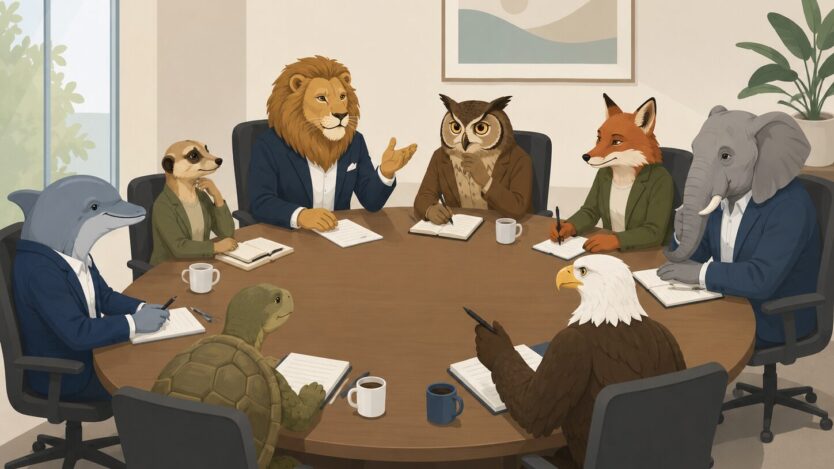
There’s an image that’s used in many leadership and governance courses of a boardroom table surrounded by different animals. It’s a simple illustration, but it’s one that has always stayed with me. Each animal represents a different personality, a different communication style and a different way of approaching decisions. No one is right or wrong, they’re simply different, and each brings something valuable to the discussion.
I think that’s particularly relevant in a members’ club. You’re working with volunteers, elected committees, members and staff, all of whom bring different experiences, priorities and perspectives. Reading the room means recognising those differences and adapting your approach accordingly.
Some people like detailed information before making a decision, others are instinctive, some are happy to challenge an idea openly, while others prefer to reflect before speaking. It’s about recognising what’s not being said. Sometimes the quietest person in the room has the most valuable contribution, or you can sense that people need more time or information before they’re comfortable making a decision or voicing an opinion.
I don’t believe reading the room is about telling people what they want to hear or avoiding difficult conversations. It’s about creating an environment where different personalities feel able to contribute, where people are listened to with respect and where decisions are reached because all perspectives have been properly considered.
How much of effective leadership comes down to self-awareness?
Self-awareness is probably one of the most important qualities a leader can have because it influences almost every decision you make and every conversation you have.
It’s also something that develops over time. I certainly don’t think it’s something you either have or you don’t. Every experience, every difficult conversation and challenging decision teaches you something about yourself, if you’re prepared to reflect on it.
Earlier in my career, I was probably my own biggest critic. If I came away from a meeting thinking, “I could have handled that better,” I’d dwell on it for far too long. Looking back, I realise that wasn’t particularly helpful. Of course, it’s important to reflect, but it’s equally important to recognise that none of us gets everything right all of the time.
Now, if I feel I could have approached something differently, I try to understand why, learn from it and move on. That’s how we improve. I’ve learnt that striving for perfection is unrealistic. What matters is reflecting, learning and trying to do a little better next time.
Why do you think some managers are able to gain support and bring people with them more easily than others?
Over the years I’ve worked with some exceptional leaders, and I’ve often reflected on what made people want to follow them. It wasn’t because they always had the answers or because they were the loudest voice in the room. It was because people trusted them. They listened, they communicated well and they made people feel involved in the journey.
It’s easy to focus on making the right decision, but if people don’t understand why you’ve made it or feel they’ve been excluded from the process, even the best decision can be met with resistance. On the other hand, when people feel listened to, respected and involved, they’re much more likely to support a decision, even if it isn’t exactly what they wanted.
That’s something I consciously strive to do. I try not to be reactive or make decisions in isolation. Wherever possible, I believe in involving people early, asking for their views and understanding different perspectives before reaching a conclusion. Whether that’s with members, staff, committees or the Board, that input is invaluable. It often leads to better decisions and, just as importantly, it creates a shared sense of ownership.
For me, bringing people with you isn’t a leadership technique, it’s a mindset. It’s something I work on every day because I really believe the best and most sustainable outcomes are achieved when people feel they’re part of the process, not simply on the receiving end of it.
What behaviours help build trust across different stakeholder groups?
I don’t think trust is built on the back of one big decision or one great speech. It’s built over time through consistent behaviours.
For me, the most important one is being genuine. People can usually tell if you’re trying to be someone you’re not. I’ve always believed it’s far better to be yourself than to try to fit an idea of what a leader should look or sound like.
Honesty and transparency are equally important. If I know the answer, I’ll give it. If I don’t, I’m now quite comfortable saying, “I don’t know, but I’ll find out.” People generally don’t expect you to know everything. What they do expect is honesty.
At the beginning, I worried that saying “I don’t know” would make people question whether I was capable of doing the job. Looking back, I couldn’t have been more wrong. I’ve learnt that saying “I don’t know, but I’ll find out” builds far more trust than pretending to have every answer.
I think consistency is another key part of trust. People don’t expect you to make everyone happy all of the time, but they do expect you to be fair, approachable and consistent in how you deal with people. That’s particularly important in a members’ club where you’re working with so many different stakeholder groups.
Can you share an example of a real club situation where emotional intelligence, listening or careful communication helped you reach a better outcome?
Our course redevelopment is probably the best example I can give because it wasn’t just a construction project, it was a people project.
I moved into this role in June 2023, just as the project was gathering momentum. One of my first priorities was engaging with the membership ahead of the SGM vote to approve the first phase of the redevelopment. It was a significant investment for the club and, understandably, members had lots of questions and, quite rightly, they expected answers. Some were excited, others were uncertain and some were firmly against it.
That early engagement was incredibly important because people needed to understand not only what we were proposing, but why it mattered for the future of the club.
Once the project was approved, communication became just as important as the construction work itself. For almost eight months, members supported a temporary 16-hole routing while construction continued. That required patience from everyone and placed even greater importance on regular communication.
Perhaps the biggest challenge came when the construction work had been completed on time and under budget, which the whole project team was incredibly proud of, but the new holes simply weren’t ready to open. The prolonged dry weather and the impact of a nematode infestation meant that opening them would have risked damaging years of work.
I knew that decision would disappoint members. It would have been easy to focus on the frustration, but instead we concentrated on explaining the reasons behind the decision, keeping members informed and acknowledging their disappointment. We couldn’t change the outcome, but we could ensure members understood why the decision had been made.
Looking back, I think the biggest lesson I learned wasn’t about building golf holes. It was about member engagement and communication. Communication isn’t something you do once a decision has been made; it’s part of the decision itself. I don’t think we built trust because everyone agreed with every decision. We built trust because members understood why those decisions had been made.
Get involved…
The GCMA has refreshed the Advanced Management Programme Leadership Award – introducing an updated programme providing Golf Club Managers with a high-quality immersive learning and personal development experience.
Designed and delivered by specialist training provider Progrezo, the three-day residential programme brought together under the Leading and Managing People banner sees delegates examine a range of topics including leadership styles, performance management, coaching and feedback, emotional intelligence, difficult conversations and stakeholder influence, while also developing a personalised plan for professional growth.
The next course is hosted at Moor Park Golf Club, from October 6 to 8. Click here to learn more or download the full Leading and Managing People brochure.